Residential Proxies Provide Accurate Geo-Targeted Pricing Data for Web Scraping and Market Analysis
· based on the channel Lukas Margerie
Residential proxies are essential tools for accessing accurate geo-targeted pricing data that traditional VPNs or data center proxies often fail to deliver. Unlike VPNs that route traffic through centralized servers which websites can easily detect and block, residential proxies use IP addresses assigned by real home internet providers, making each request appear as if it originates from an actual local user. This feature is invaluable for web scraping tasks, such as uncovering hidden or regional price differences across countries.
What Are Residential Proxies and How Do They Work
Residential proxies route your internet requests through devices connected to real home ISPs, resulting in IP addresses that websites recognize as legitimate residential users rather than data centers. This prevents many anti-scraping measures employed by websites, allowing access to content and pricing that is typically geo-restricted or personalized based on location. Residential proxies also support rotating IPs, meaning each request can come from a different residential IP, further reducing the chance of detection and blocking.
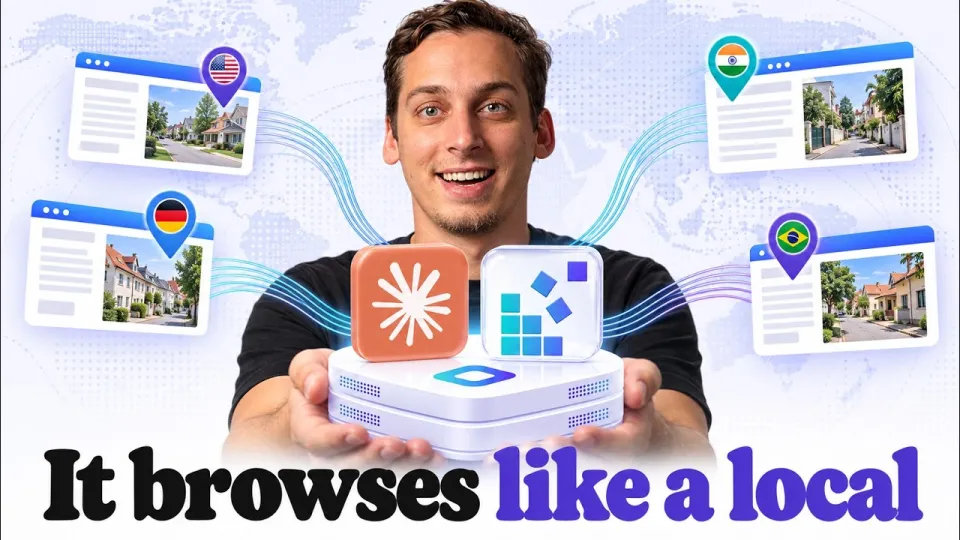
Video: This Claude Code Agent Uses Residential Proxies to Find Hidden Prices
Comparing VPNs and Residential Proxies for Web Scraping
A VPN generally routes all your internet traffic through a single server, often located in a data center. Websites recognize these IPs as belonging to commercial data centers and frequently flag or block them to prevent scraping or circumvention of geo-restrictions. In contrast, residential proxies use actual home ISP IPs, making each request appear as a local user. This distinction enables residential proxies to effectively bypass regional restrictions and acquire accurate localized data such as SaaS pricing or streaming service costs.
The Importance of Rotating Residential Proxies
Rotating proxies dynamically assign new exit IP addresses for every connection or request. This rotation is crucial for large-scale scraping operations to avoid IP bans and CAPTCHAs. Residential proxy providers like DataImpulse offer rotating pools of IPs from multiple countries, enabling scraping tools to simulate users from different regions seamlessly. This capability is vital for gathering pricing data for services like Spotify, Canva, ChatGPT, and Netflix, which often have significant price variations based on country.
Using Residential Proxies with AI Agents and Automation Tools
In the example from Lukas Margerie’s channel, a Claude Code agent combined with Playwright automation uses residential proxies to open pricing pages in various countries including the US, Germany, Brazil, and India. This agent collects and consolidates pricing data into a single detailed teardown without manual intervention or VPN reliance. Such automation is highly efficient for SaaS sellers and market analysts who want to understand regional pricing strategies and optimize their offerings accordingly.
Regional Pricing Insights Enabled by Residential Proxies
Many SaaS and subscription services implement geo-targeted pricing, charging dramatically different rates depending on the user's country. For example, Spotify Premium costs about $12.99 per month in the US but approximately $1.45 in India. Canva Pro is $144 a year in the US compared to $42 in India. By leveraging residential proxies, businesses and consumers can uncover these hidden price differences, enabling better price comparisons, competitive analysis, and potentially locating more affordable subscription options.
Practical Recommendations for Choosing Residential Proxies
- Select a provider with a large pool of residential IPs across multiple countries, such as DataImpulse.
- Ensure the proxies support rotation to maintain anonymity and reduce blocking risks.
- Integrate proxies with automation tools like Playwright and AI agents such as Claude Code for efficient data extraction.
- Verify proxy reliability and speed to handle real-time scraping without latency or downtime.
- Use country targeting features, such as username suffixes, to specify IP locations for precise geo-targeting.
Useful Links
- DataImpulse residential proxies for web scraping
- Claude Code AI agent
- Playwright automation tool
- Lukas Margerie’s channel on X
- Lukas Margerie’s LinkedIn
Итог
Residential proxies are powerful tools for bypassing geo-restrictions and uncovering hidden, region-specific pricing that VPNs and data center proxies cannot access reliably. By using rotating residential IPs from providers like DataImpulse and combining them with automation platforms such as Claude Code and Playwright, users can efficiently scrape and analyze pricing data from multiple countries simultaneously. This approach provides actionable insights for SaaS companies, marketers, and consumers looking to understand or leverage regional pricing differences. For a hands-on example and detailed tutorial, the channel Lukas Margerie offers an excellent resource showcasing these techniques in practice. Explore DataImpulse for an effective residential proxy solution that supports such advanced web scraping needs.
Key takeaways
- Residential proxies use real home ISP IPs to appear as local users.
- They enable scraping of geo-targeted pricing and content inaccessible via VPNs.
- Rotating residential proxies refresh IPs to avoid detection and blocking.
- Claude Code combined with residential proxies automates multi-country price analysis.
- DataImpulse offers a leading residential proxy service suitable for web scraping.
Questions & answers
What is the key difference between a VPN and a residential proxy?
A VPN routes all traffic through a single data center server, which websites can detect and often block. A residential proxy uses IP addresses assigned by real home ISPs, making each request appear as a local user, thus avoiding many anti-scraping blocks.
Why are rotating residential proxies important for web scraping?
Rotating residential proxies change the exit IP address with each connection, reducing the chances of IP bans or CAPTCHAs. This allows large-scale scraping without interruption or detection.
Can residential proxies help reveal different prices for the same service across countries?
Yes, residential proxies enable access to regionally restricted pricing by making requests appear to originate from users' actual locations, revealing hidden or varied prices such as for Spotify, Canva, and Netflix.
How can I use residential proxies with automation tools?
Residential proxies can be integrated with automation frameworks like Playwright and AI agents like Claude Code to automate data extraction from multiple countries simultaneously, enabling efficient and comprehensive web scraping.
Source: This Claude Code Agent Uses Residential Proxies to Find Hidden Prices · Markdown version